Use a semicolon between two independent clauses that are connected by conjunctive adverbs or transitional phrases. These words sometimes show up in other parts of a sentence; therefore, the semicolon rule only applies if it helps the conjunctive adverb join two independent clauses. (See what we did there?) This conjunctive adverb rule is similar to the conjunction rule.

In both cases, check that the two ideas are independent clauses that could stand on their own as sentences. If so, then you're grammatically good to go as far as the semicolon is concerned. Unlike the coordinating conjunction "but," "however" is not used to link two independent clauses in a single sentence. As such, if you want to use it to contrast two points, you need to make sure they are both complete sentences. The conjunctive adverb however signals a connection between two independent clauses, and commas should not be used to connect independent clauses if there is no coordinating conjunction. A common problem writers face is the incorrect usage of conjunctive adverbs.

Many times it is because they confuse them with coordinating conjunctions. When you have a conjunctive adverb linking two independent clauses, you should use a semicolon. Some common conjunctive adverbs include moreover, nevertheless, however, otherwise, therefore, then, finally, likewise, and consequently. An independent clause is a unit of grammatical organization that includes both a subject and verb and can stand on its own as a sentence.

In the previous example, "I went running" and "I saw a duck" are both independent clauses, and "and" is the coordinating conjunction that connects them. We saw in sentence structure that a compound sentence is two independent clauses joined by a coordinating conjunction or semicolon. So a compound sentence is like two or more simple sentences added together. A compound sentence does not contain any dependent clauses. Hopefully, you noticed an important difference between the two in punctuation. This is because "but" is a coordinating conjunction and exists to connect sentences.

Because of the nature of the beast, only a comma is required before the conjunction when combining two independent clauses. Use a semicolon to replace a comma when you use a coordinating conjunction to link independent clauses that already contain commas. As you may recall from above, an independent clause has a subject and a verb and can stand on its own as a sentence. Often, a coordinating conjunction will connect two independent clauses — like the word "but." Both parts of the sentence are independent clauses, and commas should not be used to connect independent clauses if there is no coordinating conjunction.

However is a conjunction, meaning that it is a word used to connect clauses in a sentence. However connects independent clauses, which are phrases that could be stand alone sentences, meaning that they contain a subject and an action. All of these examples create comma splices because there are complete sentences to the left and the right of the conjunctive adverbs however, therefore, and moreover. The commas after "growth," "hunger," and "poet" create the comma splices. Here is the correct way to punctuate these sentences. The adverb "however" means "to whatever extent or degree".

It's typically used in sentences to merge two independent clauses to make a single, compound sentence. The term could be used in the middle of a sentence, with or without punctuation. Use a semicolon between independent clauses joined by a coordinating conjunction if the clauses are already punctuated with commas or if the clauses are lengthy. Enclosed by commas it underlines what precedes it, often with contrast.
Without either it points to the contrast without emphasis; this lets you avoid unnecessary punctuation where no ambiguity is likely to arise. Use a semicolon to join two related independent clauses in place of a comma and a coordinating conjunction . Make sure when you use the semicolon that the connection between the two independent clauses is clear without the coordinating conjunction.
How To Correctly Use However In A Sentence The comma after the word 'however,' on the other hand, is necessary whether the transitional adverb opens a new sentence or is preceded by a semicolon. The importance of the comma after 'however' in such constructions becomes clear when the other uses of the adverb are acknowledged. Even the tiniest piece of punctuation can make a significant difference in the success of an author's logical transitions. Using the right transitional words in the right places can increase an author's ability to express the movement of thought and the relationships between ideas in a sophisticated research-based argument.
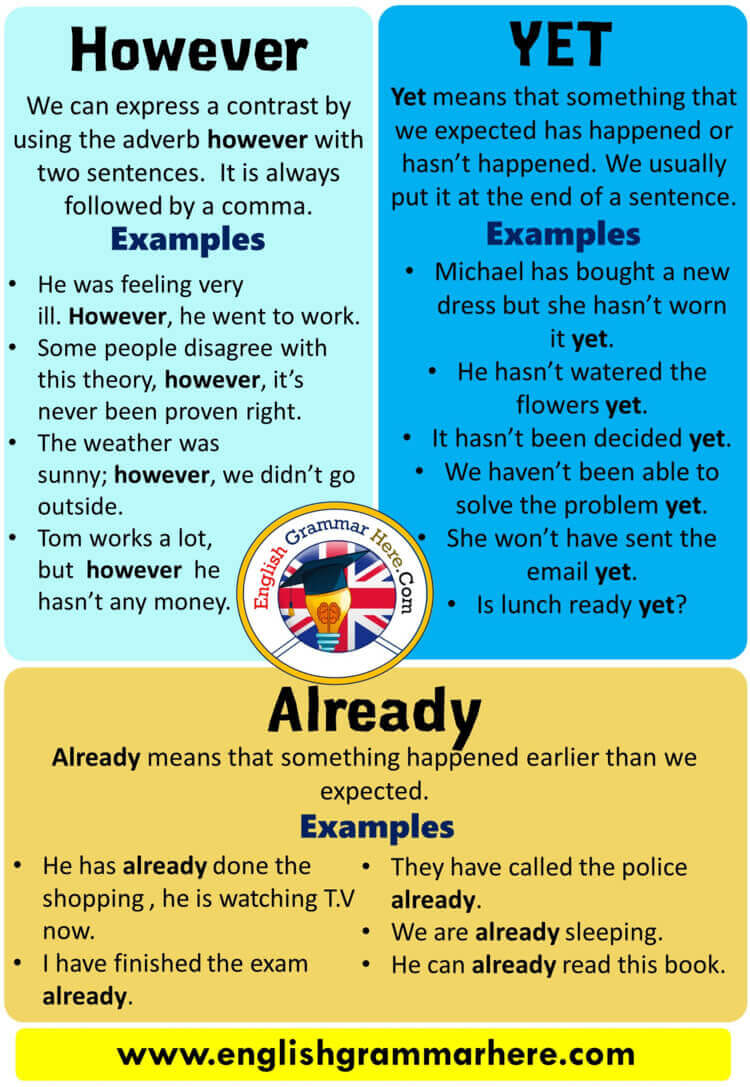
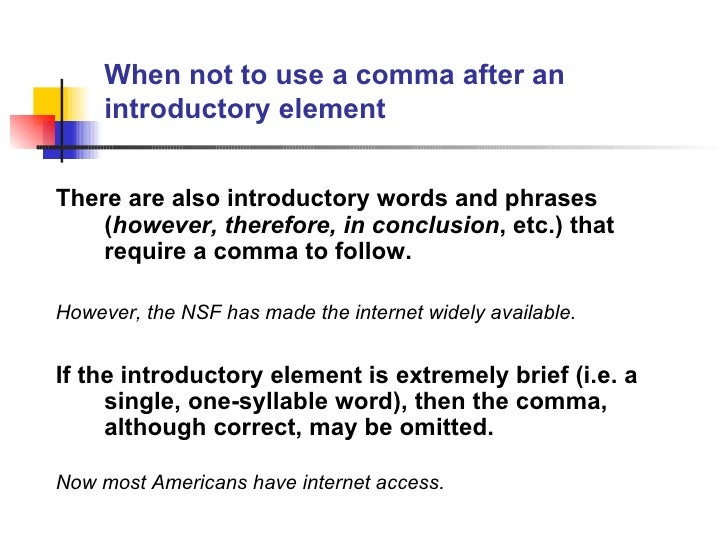
Using inappropriate transitional words or placing them in the wrong positions tends to misrepresent an author's ideas and thought processes and can confuse even highly engaged and informed readers. We can also join independent clause with words and phrases like moreover, however, at least . In this case, the conjunctive adverb must be preceded by a semicolon (;) and followed by a comma . A semicolon is most commonly used to link two independent clauses that are closely related in thought. When a semicolon is used to join two or more ideas in a sentence, those ideas are then given equal position or rank.

Possibly, the only similarity between "but" and "and" is the punctuation usage. Both do not have commas after them, and they also usually have just a comma right before when merging two independent clauses instead of a semicolon, unlike "however". Use a semicolon to join two related independent clauses in place of a comma and a coordinating conjunction. In this way, we enable our clients to report their research in the clear and accurate ways required to impress acquisitions editors and achieve publication.

The two independent clauses in the sentence are related to the same topic, so it's fitting to connect them with a semicolon rather than write two short sentences. ; at least,The table shows all seven coordinating conjunctions, and a few conjunctive adverbs as examples. Usually, we join independent clauses with one of the seven coordinating conjunctions. Most of the time, problems occur when the writer uses a conjunctive adverb in the middle of a sentence when a coordinating conjunction is actually needed. But remember that conjunctive adverbs can be used in any part of a sentence. When two independent clauses come together to make a compound sentence, "however" is used with a semicolon (;) before it and a comma right after.

But "however" does exhibit a relationship between two clauses as more rhetorical or semantic than grammatical. But when "however" is not used as a "conjunction" or doesn't link two independent clauses, it has no preceding semicolon. A semicolon may be used between independent clauses joined by a connector, such as and, but, or, nor, etc., when one or more commas appear in the first clause. As a connector word, specific rules govern the usage of "however." Many people struggle to use the word properly because it is a conjunctive adverb rather than a conjunction. Some also pause when wanting to start their sentence with it. I did a bit of research and found that not everyone agrees on when to call it a conjunction and when to call it an adverb.

Some references would call "however" in your example a conjunction, some an adverb, and some a conjunctive adverb. A compound-complex sentence contains at least two independent clauses and at least one dependent clause. The most common use of the semicolon is to join two independent clauses without using a conjunction like and. We use 'although' and 'despite / in spite of' to connect two clauses in the same sentence. On the other hand, 'however' isn't used to connect two clauses. Instead, we usually put the two ideas in two separate sentences.

We put 'however' in the second sentence, and we can put it at the beginning, at the end, or after the subject.I love London. Beware of putting a comma before "but" every single time. It should only be used when connecting two independent clauses . However is also an adverb in this case, and it is used to show contrast or opposing ideas.

The difference is in the placement of the word, which also affects its strength. In these next two positions, however is not directly following one idea and preceding the next, so as you can guess, it's not as strong of a contrast. However in these positions is also known as a nonessential adverb or a parenthetical adverb.

It is not essential or as important to the meaning of the sentence. The idea is that you could remove however without it affecting the meaning of the rest of the sentence that much. Use a semicolon between related sentences when the second sentence starts with either a conjunctive adverb or a transitional expression.

Phd thesis editing find out more about our phd thesis editing and proofreading services across all academic fields to improve language, formatting and sentence structure. Another popular way of connecting sentences is through the use of punctuation marks—namely colons and semicolons. When using this method, it is important to keep in mind how the connecting sentences are related. For instance, colons should introduce a list, example, or explanation of the previous idea.
Consider the sentences below and pay attention to how the colon is used in each sentence. These new sentences sound more formal, but still correct. It's worth adding the relative pronouns back to relative clauses in formal writing to make sure readers understand your meaning.
But — and it's a big but — your middle school teacher may have told you to always throw a comma before "but." Don't do that! You should only put a comma before "but" when connecting two independent clauses. Many adverbs end in "ly" and answer the question "how?" How did someone do something? Adverbs that don't end in "ly," such as "when" or "while," usually introduce a dependent clause, which rule number two in this post already covered.

Commas are needed before coordinating conjunctions, after dependent clauses , and to set off appositives. An em dash—inserted by typing Control+Alt+Minus between the words it separates—signals an abrupt break in thought. It can be seen as "surprising" the reader with information. If used judiciously it can mark a longer, more dramatic pause and provide more emphasis than a comma can. If overused, it creates an impression of haste and carelessness and can diminish cohesion in your paragraphs.

Em dashes are useful in early drafts to capture thoughts and afterthoughts, but in revising you may need to delete them in favor of punctuation marks that better express your ideas, such as commas . Think carefully before peppering your papers with them. There are a few ways to use however correctly, but it cannot be a substitute for but. The easy solution is to separate the two clauses with a period or a semicolon, and begin the second clause with the conjunctive adverb. Transition words and phrases, also called linking or connecting words, are used to link together different ideas in your text.

They help the reader to follow your arguments by expressing the relationships between different sentences or parts of a sentence. It's easy to write fragment sentences when you start them with, "However." If a sentence begins, "However, …" it needs to be followed by an independent clause! Check all your sentences that contain it to make sure they are complete. Pay close attention to comma usage in complex-compound sentences so that the reader is easily able to follow the intended meaning.

If a sentence begins with a dependent clause, note the comma after this clause. If, on the other hand, the sentence begins with an independent clause, there is not a comma separating the two clauses. A complex sentence contains at least one independent clause and at least one dependent clause. Dependent clauses can refer to the subject the sequence/time , or the causal elements of the independent clause. Like many grammar rules, the idea of avoiding prepositions at the ends of sentences is a rule you can break — if you know why you're doing it.

However, it may still be worth revising your sentences to avoid ending them with a preposition whenever possible if you wish to reduce the risk of controversy. Clear up any preposition misunderstandings with these tips on determining whether to use in or on in your writing. Commas always follow these clauses at the start of a sentence. If a dependent clause ends the sentence, however, it no longer requires a comma.

Only use a comma to separate a dependent clause at the end of a sentence for added emphasis, usually when negation occurs. The last example is not correct because "thus" cannot join two independent clauses. Parentheses also signify a break in thought, but they mark an addition of information rather than an interruption like dashes do. Rather than a surprise , parentheses are a gentler insertion in your sentence.

Also like dashes, parentheses should be used sparingly. Too many can break the clarity and flow of your ideas. Another thing to keep in mind is that they are often seen as casual in tone, so make sure they are appropriate for the style of writing you are using. If not, punctuation marks such as commas are often more academically appropriate. Do not try to join independent clauses with a comma alone—that's impossible!

Occasionally, we join independent clauses with a semicolon (;). The most common of these coordinating conjunctions are and, but and or, in that order. Note that a comma must come before the coordinating conjunction except when the clauses are short . Using conjunctions Conjunctions can connect words, phrases and clauses. The three main types of conjunction are coordinating, subordinating and correlative.

Placed at the beginning it can also reduce emphasis, by making your reader wait for the subject, however momentarily. The conjunctions usually have just one comma before them when used somewhere in the middle of a sentence. When they are not merging two dependent clauses or one independent and one dependent clause, even the solitary comma could be missing. To introduce a sentence that contradicts or contrasts with the previous sentence, start it with "However,…" This will alert your reader that a shift is forthcoming. Always put a comma after the "However," and follow it with a complete sentence. A simple sentence contains a subject and a verb, and it may also have an object and modifiers.

Learn more about our affordable journal article editing and proofreading services for researchers across all academic and scientific journals. Plagiarism is a serious issue for writers and editors and is considered copyright infringement. It is particularly serious for academic researchers because plagiarizing someone else's work in a research document can diminish or even destroy their professional credibility. Any works that you refer to in your writings that are not your original thoughts or ideas should be correctly cited and referenced.


